2026-12-17
The Cheapest Network to Send USDC
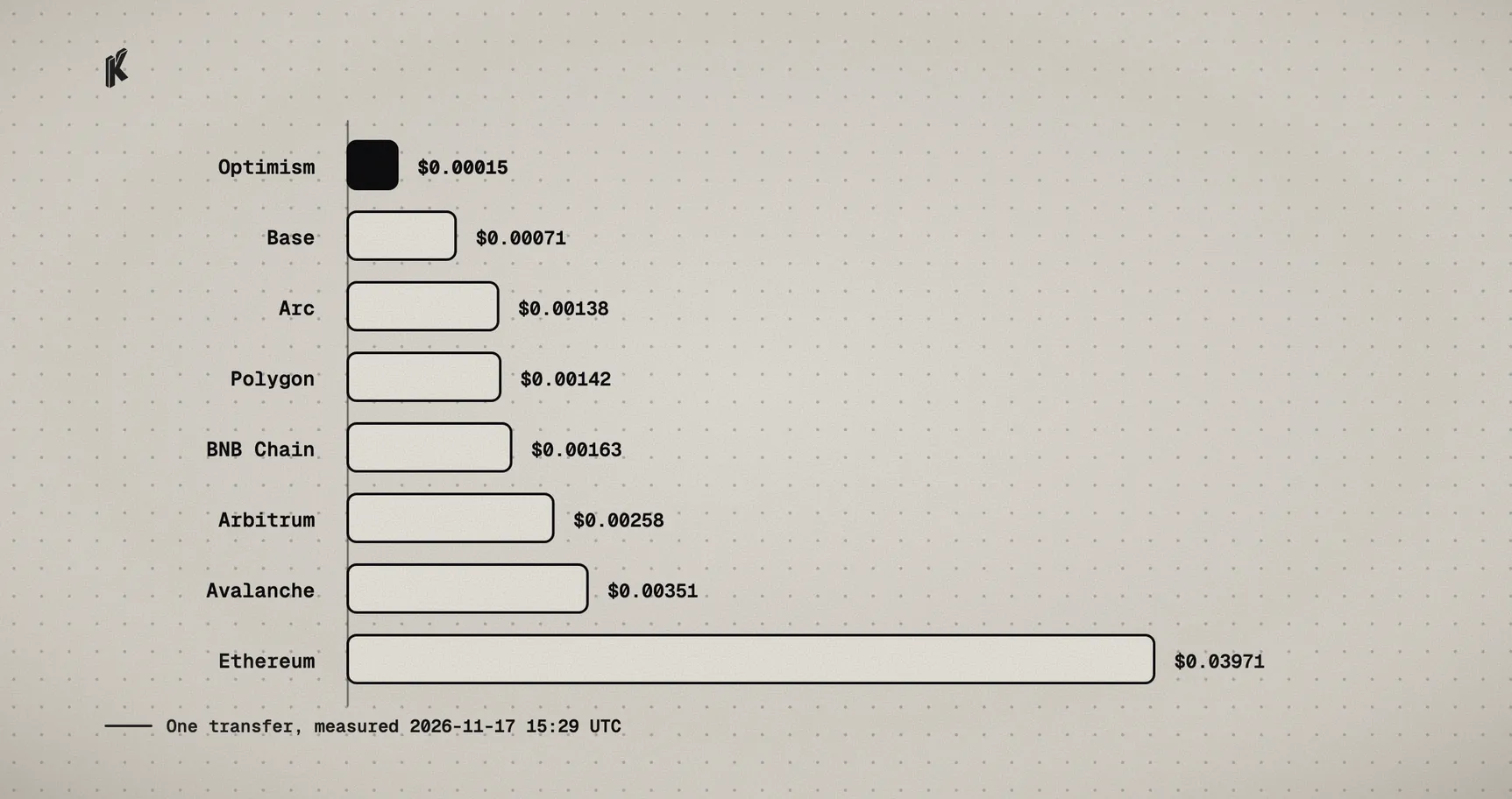
Sending 10 USDC costs about the same on every network in one respect: the token charges nothing. What differs is the fee the network takes for including the transfer, and among the eight networks Klap supports that fee spans two orders of magnitude. The cheapest and the dearest don't move together, and the reasons are a few separate ones that stack.
Below is one measured snapshot, how the number is built, and what each network adds or avoids. If you want to know who ends up paying that fee on a Klap payment, that's in does USDC have gas fees. This post is only about what the transfer costs.
A snapshot
We measured these on 2026-11-17 at 15:29 UTC, using the same code and the same public RPC nodes as our free stablecoin transfer cost tool. Each figure is the estimated cost in US dollars of one stablecoin transfer, sorted cheapest first.
| Network | Gas units assumed | Gas price | L1 data fee included | Estimated cost |
|---|---|---|---|---|
| Optimism | 65,000 | 0.0012 gwei | yes | $0.00015 |
| Base | 65,000 | 0.006 gwei | yes | $0.00071 |
| Arc | 55,000 | 25 gwei | no | $0.00138 |
| Polygon | 65,000 | 266.7 gwei | no | $0.00142 |
| BNB Chain | 55,000 | 0.05 gwei | no | $0.00163 |
| Arbitrum | 70,000 | 0.020 gwei | yes | $0.00258 |
| Avalanche | 65,000 | 7.5 gwei | no | $0.00351 |
| Ethereum | 65,000 | 0.338 gwei | no | $0.03971 |
That's a single reading, taken once. Gas prices change every block, and the native token prices behind the dollar figures change all day, so a reading from another hour can reorder the middle of the table. Treat it as the shape of the comparison. The live figure is at klappay.com/tools/stablecoin-transfer-cost.
In this reading Ethereum cost about 260 times what Optimism did, and about 55 times what Base did. The five networks in the middle sit within a quarter of a cent of each other.
How the number is built
The tool uses one formula for every network: the gas an ERC-20 transfer uses, times the gas price, plus any fee for publishing data to Ethereum, converted to dollars.
The gas units are one conservative figure per network and not a measurement of a particular transaction: 65,000 on Ethereum, Base, Optimism, Polygon and Avalanche, 70,000 on Arbitrum, and 55,000 on BNB Chain and Arc. USDC and USDT use a similar amount of gas, so the same figure serves both. It assumes the recipient already holds the token. A first transfer to a brand-new holder costs more, because the contract writes a new balance.
The gas price is read from the network's own node. The dollar conversion uses the native token's Chainlink price feed on that network, and a price that is missing, zero or more than 24 hours old is never used.
Why the same transfer costs different amounts
The gas price isn't comparable between chains. Polygon's reading is 267 gwei and Ethereum's is 0.338 gwei, which looks like Polygon is almost eight hundred times worse. It isn't, because a gwei is a billionth of the chain's own token, and POL is worth far less than ETH. The only comparable figure is the dollar cost, which is why the last column is the one that counts.
Ethereum pays for being the base layer. A transfer on Ethereum is executed and stored by the network that everything else settles to, and its block space is the scarce one. Its fee is the plain product of gas units and gas price, with nothing else added, and the gas price there moves with how busy the network is.
OP-stack chains run cheap and add a second fee. Base and Optimism execute your transaction on their own chain for very little, which is why their gas prices are fractions of a gwei. But they also publish the transaction's data to Ethereum so that anyone can rebuild the state, and the user pays for that as the L1 data fee. The tool asks the chain's GasPriceOracle for that fee on a 115-byte transfer and adds it to the L2 gas cost.
Arbitrum charges for L1 calldata too. It prices the data by the byte. The tool reads the per-byte price from the ArbGasInfo precompile, multiplies it by the same 115 bytes and adds the L2 gas cost. Its gas-unit figure is also a little higher than the others, 70,000, which is part of why it lands above Base and Optimism in this reading.
Polygon, Avalanche and BNB Chain run their own fee markets. There's no data fee to add. The cost is gas times that chain's gas price times its native token's price, so each lands wherever its own demand and token price put it. BNB Chain's lower gas units, 55,000, help it a little.
Arc has no price conversion. Arc is Circle's chain, and gas on it is paid in USDC itself. The cost is gas used times gas price, already in dollars, with no price feed in between and no second token for the sender to hold. We wrote more about the network in accepting USDC on Arc.
What the numbers leave out
The estimate is not a quote. A wallet adds its own safety margin on top, the gas price moves between the moment it's read and the moment your transaction lands, and a transfer to a fresh address costs more than the figure shown.
Cost also isn't the only thing that picks a network. Where your payer's funds already are matters more than a tenth of a cent. A customer with USDC on Ethereum and no ETH on Base isn't helped by Base being cheaper, because moving over costs them more than the saving. Finality differs too, and the confirmations you wait for before treating a payment as final aren't the same on each chain, which how many confirmations a payment needs covers.
The two stablecoins also aren't available everywhere, and Arc has USDC only. USDC vs USDT for merchants covers that side.
For a small payment, the gap between networks is large relative to the amount, and it's the reason a checkout is better off offering more than one network than only the one you happen to prefer. For a large one, the fee is a rounding error and the choice is about everything else.