2026-10-15
Crypto Payments Are Fast. The Tooling Is Not.
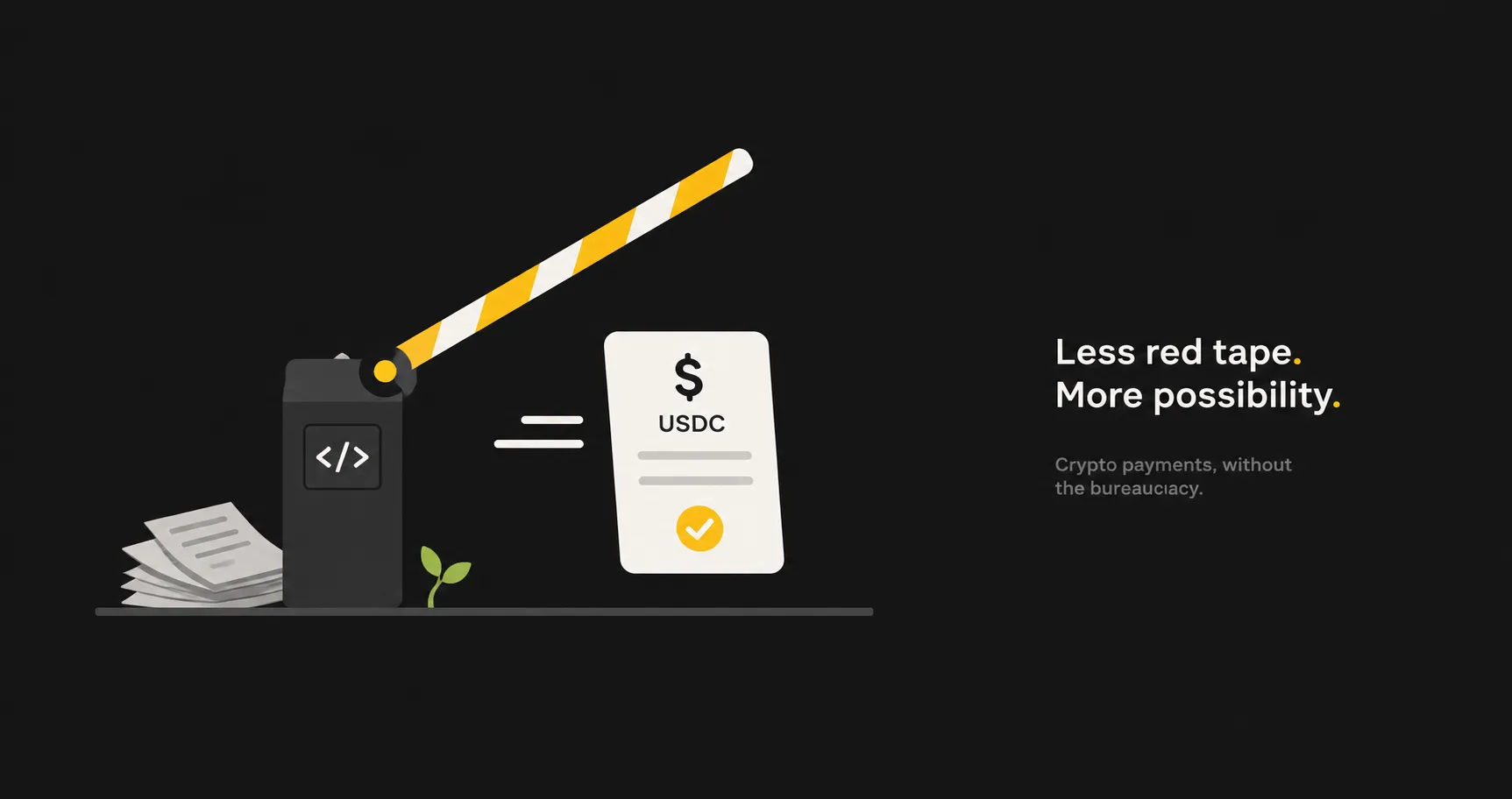
The blockchain is not the problem.
USDC settles in 2 seconds on Base. Fees are fractions of a cent. The technology is ready. What is not ready is the layer of tooling built on top of it — the gateways, the SDKs, the documentation, the developer experience.
Accepting crypto payments in 2026 is still harder than it should be. Not because of the blockchain. Because of everything in between.
What bureaucracy looks like in crypto payments
When a merchant tries to accept USDC today, they run into the same set of problems:
Custody. Most gateways receive the customer's payment into their own wallet first. Then they decide when to release it to you. Your money sits in someone else's account, subject to their withdrawal rules, their review processes, and their schedule. That is not crypto — that is a bank with extra steps.
Integration time. The documentation is outdated. The sandbox does not work. The SDK has no TypeScript types. What should take an afternoon takes a week. And when something breaks in production, there is no audit trail to inspect — just a support ticket and a wait.
Missing primitives. A marketplace needs to split a payment between a seller, a platform, and a partner. A creator platform needs to route a donation directly to a wallet. A SaaS needs webhooks that survive retries and idempotent event handling. None of this should require custom infrastructure. It should be in the API.
These are not blockchain problems. These are product problems. And they are solvable.
What we mean by removing the friction
Klappay is built around one idea: the infrastructure should get out of the way.
Funds go directly to the merchant. There is no intermediary wallet, no processor balance, no withdrawal queue. When a customer pays, the money goes on-chain to the merchant's address through an audited, immutable smart contract. We detect and coordinate the payment — we never own it.
Integration takes minutes, not days. The Node.js SDK ships the same Zod schemas as the API. Types match. The sandbox simulates every state — confirmed, expired, underpaid, duplicate event — without spending real funds. From zero to first confirmed payment in under 5 minutes.
The primitives are built in. Native split payments, deterministic addresses per charge, SSE for real-time checkout updates, webhooks with signature verification and retry logic, a state machine that handles every edge case. The things developers have to build themselves with every other gateway are already there.
Why this matters beyond the technology
The cost of receiving international payments via traditional processors is 5–7% when you account for exchange rates, IOF, and processing fees. For a SaaS with customers in the US or Europe, that is money leaving the business with every transaction.
USDC eliminates the exchange rate. It eliminates the IOF. It eliminates the correspondent banking fees. The only cost is the payment infrastructure — and that should be 1%, not 7%.
But cheaper infrastructure is only useful if it is also reliable, well-documented, and fast to integrate. A gateway that saves 6% and costs two weeks of engineering time to set up is not a win. A gateway that saves 6% and takes 5 minutes is.
That is the gap we are closing.
The bigger picture
Crypto payments are not a niche use case. They are becoming the default rail for international commerce — for freelancers receiving from clients abroad, for SaaS companies with global customers, for marketplaces that need to pay sellers in different countries instantly.
The infrastructure for that future should be open, inspectable, and developer-first. It should not require trust in a processor's internal ledger. It should not require a week of integration work. It should not put a financial intermediary between a business and its revenue.
That is what we are building with Klappay. Not just a payment gateway — infrastructure for a world where moving money across borders is as simple as sending a message.
The blockchain made that possible. The tooling just needs to catch up.
Klappay is in Closed Beta. If you are building something that needs crypto payments, request access here.