2026-12-08
Your Customer Says They Paid, but You Don't See It
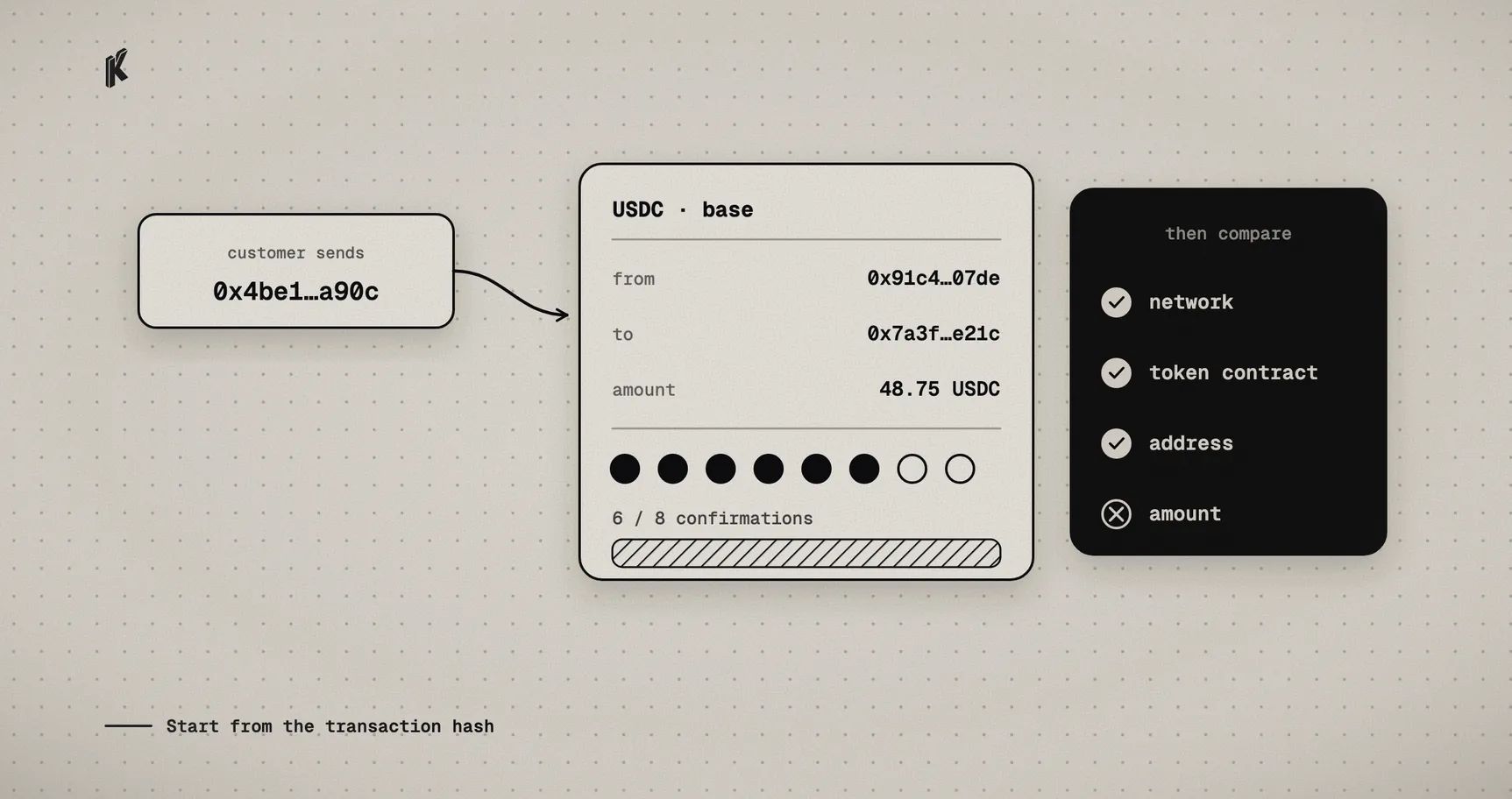
A customer writes that they paid, and the charge on your side says otherwise. Most of the time both are telling the truth. The transfer happened, just not the one your system was waiting for.
The first move is always the same: ask for the transaction hash. It's the one piece of evidence that doesn't depend on anyone's memory or screenshot. Paste it into the free stablecoin payment checker and it lists the official USDC and USDT transfers in that transaction, with the sender, the recipient, the amount and the confirmations, on Ethereum, Base, Optimism, Arbitrum, Polygon, Avalanche, BNB Chain and Arc.
One limit matters here. The checker shows what a public node observes on-chain. It doesn't know about your charge, so it can't tell you the charge was paid. What it gives you is something to compare with the charge: network, token, recipient and amount. The checklist below is that comparison, one cause at a time.
The transfer is still confirming
How to tell: the checker finds the transaction and marks it recent, with only a few confirmations.
Seeing a transfer isn't the same as it being final, and Klap doesn't credit a transfer until it is. Until then it's a sighting, not a payment. How long that takes depends on the network, from a single finalized block on Arc, Polygon and BNB Chain to 120 blocks on Arbitrum. How many confirmations a crypto payment needs has the full table.
What to do: wait. Tell the customer it's on its way, and don't fulfill until the charge is confirmed.
The wrong network
How to tell: the checker finds the hash on a different network than the one the charge asks for, or on none of them. USDC on Base and USDC on Polygon are different tokens on different chains, even when the ticker matches.
What to do: this one has no automatic fix. A transfer on the wrong network isn't a normal failed payment, and recovering it may need manual work or may not be possible at all. Be upfront with the customer about that, and show the network next to the address at checkout so the next customer doesn't repeat it.
The wrong token, or one that only looks like USDC
How to tell: the checker shows no official transfer, or says it ignored transfers of other tokens. It only counts a transfer when the log comes from the official USDC or USDT contract on that same network. Look-alike tokens that reuse the name and symbol are left out and counted, so you can see they were there.
Bridged versions, such as USDC.e on Polygon, Avalanche or Arbitrum, are separate contracts too. Klap doesn't accept them.
What to do: compare the token contract in the customer's transaction with the official one. The USDC and USDT contract addresses page lists them for every network. If the customer sent a different token, the payment didn't happen as far as your charge is concerned, and any refund or return is a conversation between you and them.
The charge had already expired
How to tell: the transfer is real and in the right token, but its block is later than the charge's expiry.
Klap keeps checking recently expired charges for an hour, so a transfer that was already on its way when the timer ran out isn't lost. A late payment on an expired address is still a real on-chain payment, and it can show up as underpaid instead of disappearing.
What to do: look at the charge's status and its amountReceived before you answer the customer. If the money arrived, decide whether to honor the order, and make a new charge if the price or the stock changed.
Paid too little
How to tell: the checker shows an amount below the charge, and the charge is partially_paid or underpaid.
The usual reason is a fee taken out of the amount. People send the price and forget the network fee, or they pay from an exchange that deducts its own withdrawal fee, so 48.75 arrives on a 49.01 charge. Klap adds up what arrives, so a second transfer for the difference completes the charge.
What to do: accept the gap, ask for the rest or refund, as you would for any short payment. Crypto underpayments and overpayments covers all three and how to put the policy in code. Transfers under $0.10 are ignored unless they complete the charge, so a tiny stray transfer won't show up as a partial payment.
Paid from an exchange
How to tell: the sender in the checker is an address you don't recognize.
That sender belongs to the exchange, not to the customer. Two things follow. The exchange may have taken a fee from the amount, as above. And if you ever need to send money back, the sending address isn't theirs, so ask for a return address first.
What to do: if the transfer matches the charge, treat it like any other payment. If the customer has no hash yet, they can ask the exchange for it.
A typo in the address
How to tell: the recipient in the checker isn't your charge's address.
Compare it character by character with the address on the charge. If it's different, the money went to an address that isn't yours, and a Klap charge can't pull it back.
What to do: be honest about it, and ask the customer to pay the charge or a new one. Paying by connecting a wallet, as with checkout-kit, means nobody types an address at all.
Before you reply
Keep the same four things in view: the charge id, the transaction hash, the network and the amount. If the hash matches a transfer to your charge's address in the right token on the right network, your charge will catch up, and webhooks are how your system finds out. If it doesn't, the checker already told you which cause you're looking at.
To keep this list shorter for the next customer, verify payments from signed webhooks and show the network and token clearly at checkout.