2026-09-09
Deterministic Addresses for Crypto Payments: Why Every Charge Needs Its Own Destination
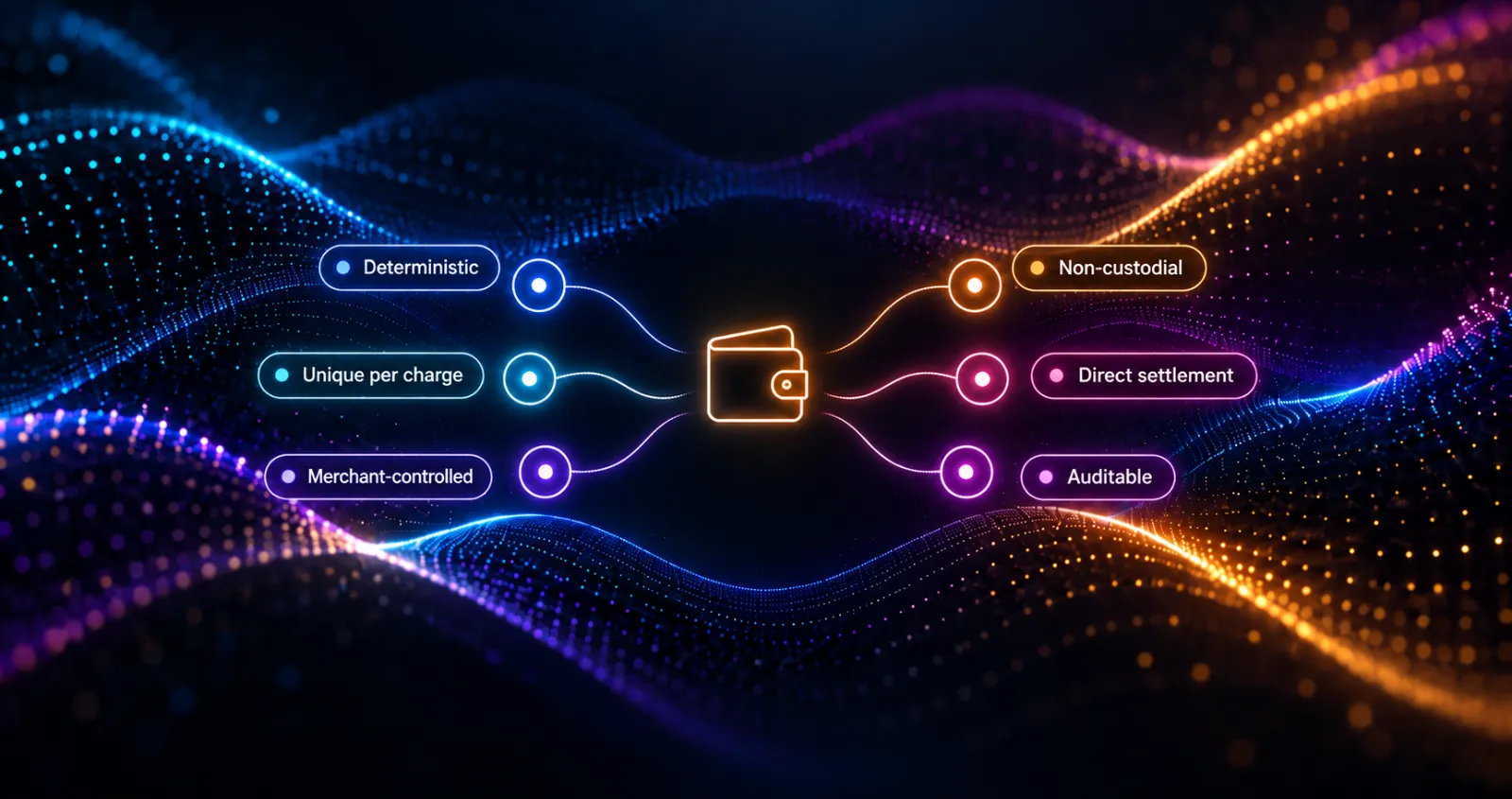
A crypto checkout should not ask a customer to send funds to a shared wallet and hope your backend figures out who paid. Every charge needs a destination that is unique, predictable, and tied to a durable record. Deterministic addresses make that possible without putting a processor between your business and its funds.
That distinction matters more than it might seem. A processor can generate an address, watch the chain, and send you a paid event while still controlling the wallet, the settlement schedule, and the rules around access to your money. A deterministic address design instead gives each payment its own on-chain destination that nobody — not even the provider — can redirect, with funds routing directly to the merchant. The payment is not an entry in someone else's internal ledger. It is a transaction your infrastructure can independently verify.
What deterministic addresses actually mean
A deterministic address is generated from known inputs according to a repeatable rule. Given the same inputs, you get the same address back. Given a new charge, you get a different address — without needing to create and store a new secret for every checkout.
Some providers derive a fresh externally owned account per charge from an HD wallet — a merchant keeps private key material in its own secure signing environment, while a payment service operates with public derivation material that can generate and monitor addresses but cannot spend from them.
Klappay takes a different route: every charge address is a smart contract, not a wallet. It's computed with CREATE2 and salted by the charge ID, using 0xSplits as the routing layer, so the address is predictable before it's ever deployed. The contract has no owner — its ownerAddress is the zero address — so once a charge is created, nobody can redirect where its funds go, not the merchant's own operator tooling and not Klappay. That is true whether the charge has one recipient or several; a "split" of 100% to the merchant and a split across a seller, platform, and affiliate are the same mechanism, not two different products.
The useful business outcome is the same either way: a charge has a clearly assigned destination, and the relationship between that destination and the charge can be inspected later. The mechanism underneath — a derived EOA versus a deployed routing contract — changes the trade-offs (more on that below), not the guarantee a merchant actually cares about.
Why shared receiving addresses fail at checkout
A shared address is easy to put on a payment page. It is also a weak payment primitive.
If ten customers are told to send 25 USDC to the same address, payment matching becomes conditional. Your system may compare amounts, timestamps, sender wallets, or a memo field if the network supports one. Each condition adds failure modes. Two customers can pay the same amount at the same time. A customer can pay late. A wallet can omit a memo. An attacker can send a dust transaction that looks like a real payment.
Reusing one address also damages privacy. Customers, competitors, and data providers can see the address's transaction history and connect payments that should have remained separate. On a public chain, this is not a theoretical concern — your receiving address becomes an index of your commercial activity.
A deterministic address per charge changes the matching problem entirely. The address itself becomes a primary identifier. When the expected token transfer lands at that destination on the expected network, your backend has a direct association to the order, subscription invoice, donation, or marketplace payout it represents.
This does not mean address uniqueness alone proves a payment is valid. It means your verification logic starts with a reliable routing key instead of guesswork.
Deterministic addresses need charge state behind them
An address is only one field in a payment system. Treating it as the entire payment record creates gaps as soon as a customer pays the wrong amount or a webhook arrives twice.
When your backend creates a charge, it should persist an immutable charge ID, the selected network, accepted asset contract, required amount, expiration policy, and the generated receiving address. The checkout renders the address or QR payload from that record. The server stays the authority on what payment is expected.
The generation operation must be safe to retry. If a customer refreshes checkout or your API client retries after a timeout, you need the same address back — not a second charge with a second address for the same invoice. That doesn't happen automatically just because you're calling the same endpoint with the same body; it happens because you pass an explicit idempotency key. Replaying the same key with the same request returns the original charge untouched instead of creating a duplicate.
Here is how that looks with Klappay:
const merchant = await klap.recipients.create({address: merchantAddress,label: 'merchant',})const charge = await klap.charges.create({amount: 49.00,expiresIn: 3600,idempotencyKey: `charge_${order.id}`,externalRef: `order_${order.id}`,acceptedPayments: [{ token: 'USDC', network: 'base' }],splitRecipients: [{ recipientId: merchant.id, percent: 100, label: 'merchant' },],})
The important part is not the function names. It is the contract around them: one business charge maps to one durable payment destination and one payment specification, and retrying that creation call is safe by design rather than by accident. If your implementation supports recipient splits, define those recipients before the customer pays. Reconstructing split logic after funds arrive is harder to audit and easier to dispute.
Verify the asset, network, and finality — not just the address
For an EVM payment, watching an address balance is not enough. Your verifier should inspect the transfer itself: the chain ID, token contract, recipient, token amount, transaction hash, and block status. Native-token transfers and ERC-20 transfers are observed differently, so your indexing logic has to understand both.
You also need a clear rule for finality. Klappay fixes a minimum confirmation depth per network, sized to that chain's own reorg risk — a transfer isn't credited until it clears that bar, so you're not choosing how many confirmations to trust. What you do choose is what happens next: a low-value digital good can fulfill the moment a charge is confirmed; a higher-value order might wait for settlementStatus to reach completed, confirming the payout actually reached your wallet rather than just landing on-chain. Neither policy is universally correct. The mistake is hiding either behind a generic paid boolean that gives your product and finance teams no idea what it actually means.
Statuses should distinguish at least: pending, partially_paid, confirmed, underpaid, and expired for the payment itself, plus a separate settlementStatus — pending, completed, failed — for whether the payout actually reached your wallet. A late payment to an expired deterministic address is still a real on-chain payment, reflected as underpaid rather than made to disappear because your checkout timer hit zero.
Keep observability separate from settlement custody
Real-time payment status is where teams accidentally accept a custodial design. They want reliable webhooks, so they let a provider hold the receiving wallet and report back when funds arrive. But those are separate concerns.
Your infrastructure can observe merchant-owned destinations and publish charge events through server-sent events, webhooks, and SDK methods — without the provider ever touching the funds. Webhooks should be signed, replay-safe, and treated as delivery notifications rather than the source of truth. Your handler should be idempotent because duplicate deliveries are normal, not an edge case.
The live event stream itself needs a secret API key, so it's meant for your backend, not a customer's browser directly. For customer-facing checkout, have your backend hold that stream open and relay progress to the page over its own channel — that's still fast enough to update the UI the moment a payment is detected. For fulfillment, a backend worker should independently consume the webhook event, validate the charge state, and record the transaction hash. If an event is missed, a reconciliation job should query charge status and chain data rather than waiting for the customer to report that they paid.
This is the model Klappay is built around: detect and route payments without ever taking custody of merchant or customer funds. The API layer improves integration ergonomics — it should not become the owner of the money.
The trade-offs worth knowing upfront
Per-charge deterministic addresses improve attribution and reduce address reuse, but they are not free.
A provider deriving addresses from an HD wallet takes on a different set of obligations than one routing through per-charge contracts: disciplined key management, a way to track which derivation paths have been assigned, and consolidation transactions to sweep funds out of many derived accounts, which costs its own gas.
A contract-routing design like Klappay's trades those for a different shape of trade-off. Nothing is ever swept or consolidated — each charge's contract routes straight to the merchant's own wallet — but "the payer's transfer landed on-chain" and "the merchant's wallet actually has the funds" become two separate steps (charge.confirmed, then a later charge.settled) instead of one. That gap is normally small, but it means settlement is itself a monitored, retryable operation with its own failure mode (settlementStatus: 'failed') rather than something that's simply true the instant a transfer is detected. It also means the mechanism only works on chains 0xSplits itself supports — it isn't a universal answer across every kind of chain a payments product might eventually add.
One more thing: do not promise privacy the chain cannot deliver. Unique addresses reduce straightforward address reuse, but every charge for the same merchant still settles to the same underlying wallet — transaction timing, transfer amounts, and that shared endpoint can still create associations. Good infrastructure reduces avoidable leakage. It does not repeal public ledger analysis.
Start with the payment destination, not the payment page
The strongest crypto checkout experiences do not begin with a wallet-connect button or a copied address. They begin with a charge model that defines exactly where funds should go, what constitutes a valid transfer, and how your application responds when reality does not match the happy path.
Make address generation deterministic, merchant-controlled, and idempotent. Then test expired invoices, duplicate events, wrong-network transfers, underpayments, and late settlement in a sandbox before real money is involved.
When those cases are handled up front, the payment address stops being a string pasted into a UI and becomes what it should be: auditable routing infrastructure for money your business actually controls.