2026-11-25
The GENIUS Act for Merchants: What Changes for USDC and USDT
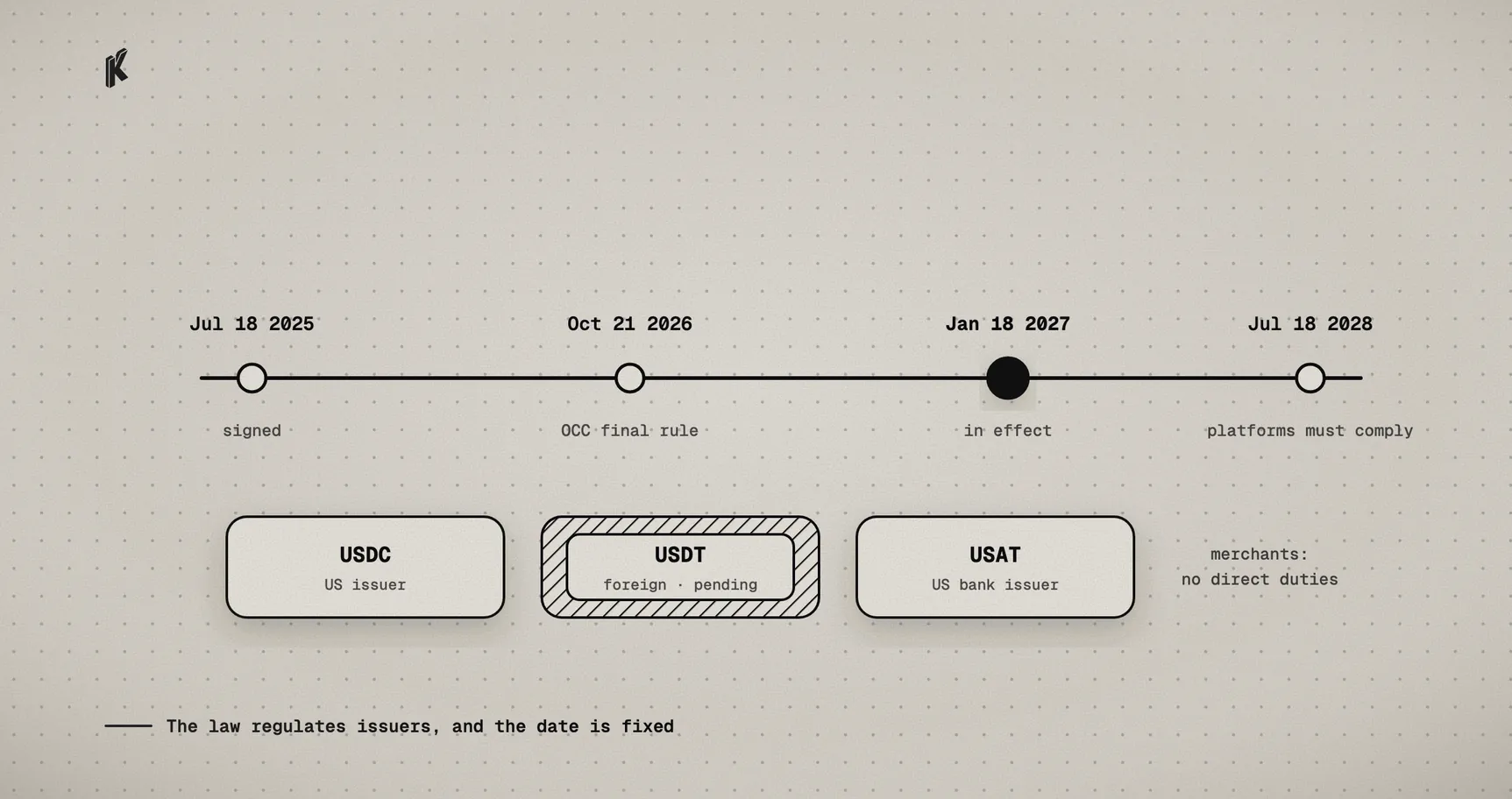
The GENIUS Act became law on July 18, 2025, and it takes effect on January 18, 2027. If you take USDC or USDT as payment, most of what changes on that date isn't aimed at you. The law is written for the companies that issue stablecoins and the platforms that sell them, so most of its rules land on Circle and Tether and on the exchanges that list their tokens. A shop that receives 49 USDC for an order is mostly outside it.
It still changes things you'll notice. Some tokens get a clear legal status in the US and some don't, and over the next two years that decides which ones your US customers can easily buy and hold. This is how it stands in November 2026. Read it as a summary. It isn't legal advice, and anything that depends on your business model is a question for your lawyer.
Why the date is January 18
The Act takes effect on whichever comes first: 18 months after it was signed, or 120 days after the main federal regulators publish their final rules. Eighteen months gives January 18, 2027.
The 120-day route can't beat that date anymore. The OCC announced its final rule on October 21, 2026, and 120 days from its publication lands in late February, after the backstop. So January 18 it is. Astraea's countdown walks through the arithmetic if you want to check it.
Most of the other rules aren't finished. As of November 1, the OCC rule and a Treasury interim rule on state regimes were the only final ones. The rules from the Federal Reserve and FinCEN, among others, are still proposals, and so are the OCC's own anti-money-laundering rules. The law takes effect on time anyway, and the details keep arriving after.
Who the law is actually for
Three groups carry the obligations.
Issuers. A permitted issuer has to back every token one to one with cash and short-term Treasuries, publish its reserves and redeem on time. The OCC rule sets two business days as the outer limit for redemption. Issuers also can't pay holders interest for simply holding the token.
Digital asset service providers. These are the exchanges and wallet providers that offer stablecoins to people in the US. Starting July 18, 2028, they can't offer or sell a payment stablecoin to US persons unless a permitted issuer stands behind it.
Foreign issuers. A company issuing from outside the US needs Treasury to decide that its home country's rules are comparable, and has to register with the OCC. Without that, US platforms can't keep offering its token past 2028.
A business that accepts a stablecoin as payment for its own goods isn't on that list just for doing so. The merchant guides we've read agree that GENIUS puts no direct compliance duties on merchants who accept stablecoins. Where it gets less simple is if you hold balances for other people, exchange tokens on behalf of customers, or advertise a return on stored funds. Those look more like the activities the law regulates, and that's where you'd want a real opinion.
What happens to USDC
USDC is issued by Circle, a US company, and it's set up to go through the US regime. For a merchant, that means very little changes. Your customers keep holding it, exchanges keep listing it, and the rules about reserves and redemption are the issuer's to meet.
One thing the law locks in is the issuer's ability to freeze. A permitted issuer may only issue if it has the technical ability to comply with a lawful order to seize, freeze, burn or block transfers of its tokens. Circle already does this through its blacklist, and it isn't going away. If you pay out to other wallets, a frozen recipient can hold up a USDC split, and checking an address before you pay it stays worth doing.
What happens to USDT
USDT is the open question. Tether issues it from outside the US, so its route is the foreign-issuer one, and Treasury hasn't made a comparability decision for it. Treasury's rules for that process were also due in July 2026 and aren't final.
Tether's answer for the US market so far is a separate token. USAT launched on January 27, 2026, issued by Anchorage Digital Bank under OCC supervision. It's a different contract from USDT, with a supply that is a small fraction of USDT's, and USDT itself still isn't offered to US customers.
The deadline that matters for USDT isn't January 2027, it's July 18, 2028. That's when US platforms have to stop offering stablecoins without a permitted issuer behind them. If USDT doesn't get there by then, your US customers will find it harder to buy and move, even though nothing stops you from receiving it.
What we'd do before January
- List the issuer behind every token you accept. USDT and USAT share a brand but not an issuer, and their legal positions in the US are different. Your checkout shows them all as dollars anyway.
- Keep USDT if your customers use it. Nothing in the law stops you from accepting it today, and outside the US it's still the most used stablecoin by a wide margin. Just be able to turn it off per network without changing code.
- Don't promise yield on balances. The ban is aimed at issuers, but advertising interest on stablecoins you hold for customers is exactly the kind of thing that pulls you into the regime.
- Keep custody out of your stack if you can. A business that only ever receives payments into its own wallet has a much shorter list of questions than one that holds other people's money.
- Check freezes before payouts. The law makes the freeze function a requirement for every permitted issuer, so it will be on every token you're likely to accept.
On Klap, the token and network pairs live on each charge, so dropping one is a configuration change:
const charge = await klap.charges.create({amount: 49.0,expiresIn: 1800,acceptedPayments: [{ token: 'USDC', network: 'base' },{ token: 'USDC', network: 'polygon' },{ token: 'USDT', network: 'polygon' },],})
Payments go straight to an address that belongs to that charge and on to your wallet, without Klap holding the funds in between. If you're still choosing between the two tokens, USDC vs USDT for merchants has the numbers by network.