2026-09-13
How to Split USDC Payments Between Wallets
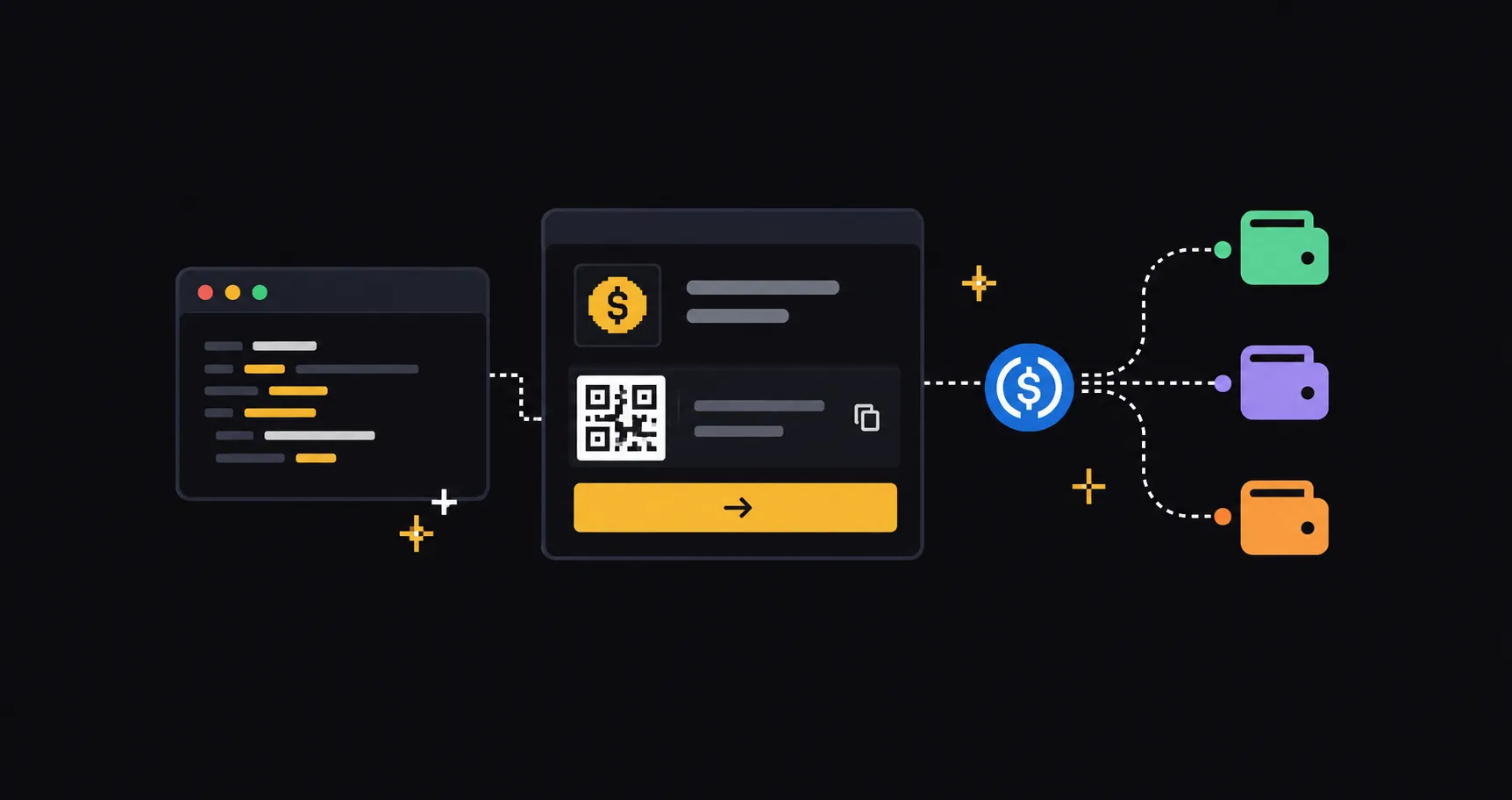
A marketplace order is not one payment destination. It may include a seller payout, a platform fee, a collaborator share, and a reserve wallet. The hard part of splitting USDC payments between wallets is not calculating percentages. It is making the allocation deterministic, observable, and enforceable without parking customer funds in a processor-controlled account.
A custodial processor can make this look easy because it receives the payment first, updates an internal ledger, and pays everyone later. That model gives the processor control over the money and turns your payout logic into a vendor dependency. A better architecture treats the split as part of the payment contract: recipients, amounts, asset, network, and charge reference are defined before the customer pays.
Why split at the payment layer
Application ledgers are useful, but they are not settlement. If a customer pays 100 USDC, your database can record that 90 USDC belongs to a seller and 10 USDC belongs to your platform. Until those balances are actually distributed on-chain, you have created an internal liability system. That means reconciliation work, payout timing decisions, operational risk, and potentially a custody problem.
Splitting at the payment layer moves the allocation closer to the event that matters: confirmed on-chain settlement. Each charge should carry a recipient plan that can be inspected later. When payment arrives, the system validates the asset and amount, associates the transfer with the charge, and executes or observes the defined distribution path.
This works well for marketplaces, affiliate programs, creator platforms, payroll tools, and protocol revenue sharing. The same primitive covers any situation where one commercial event has more than one economic owner.
Define the split before you create the charge
A split is a financial instruction, not a UI convenience. Define it server-side before exposing a payment address or a checkout action. Never let a browser submit an arbitrary recipient list and assume it is safe because the math adds up.
With Klappay, you create the recipients once per wallet address, then attach them to each charge:
const merchant = await klap.recipients.create({address: merchantWallet,label: 'merchant',})const platform = await klap.recipients.create({address: platformWallet,label: 'platform',})const charge = await klap.charges.create({amount: 100.00,expiresIn: 3600,externalRef: `order_${order.id}`,acceptedPayments: [{ token: 'USDC', network: 'base' }],splitRecipients: [{ recipientId: merchant.id, percent: 90, label: 'merchant' },{ recipientId: platform.id, percent: 10, label: 'platform' },],})
The charge now carries the full allocation plan. If a payment arrives, there is no separate step to decide where it goes — the split was defined before the customer paid.
Choose a rule that survives edge cases
Percentage splits are expressive, but define rounding behavior explicitly. If a payment of 100.01 USDC is divided 90/10, one recipient will receive the remainder unit. Decide who gets it, store that rule, and test it.
Fixed amounts are often clearer for a platform fee. For example, a 2 USDC fee plus the remaining balance to the seller avoids percentage rounding and produces predictable margins. They also require a policy for underpayment — reject it, accept it as partial, or hold fulfillment until the customer pays the difference.
Do not silently change a recipient plan after a charge is created. A seller changing their payout wallet should affect new charges, not rewrite the destination of an existing one. Version recipient configurations and keep the version on the charge record.
Also persist immutable business context — an order ID, seller ID, or invoice version. Wallet addresses alone do not explain why money moved.
How to split USDC payments between wallets without custody
Direct settlement needs some precision here. A standard ERC-20 transfer has one destination. If a customer sends USDC directly to a single address, splitting that payment across multiple wallets requires a subsequent distribution action. The alternative is a contract that atomically allocates USDC to multiple recipients as part of the same transaction.
Those are different designs, with different trade-offs.
A contract-based split distributes funds atomically — the transaction either delivers every allocation or reverts. This is attractive when all recipients must be paid at the same moment. It introduces smart-contract surface area, deployment and audit requirements, gas considerations, and a checkout flow that may be less familiar than a simple token transfer.
A deterministic payment-address design preserves a straightforward transfer flow while giving every charge a distinct, attributable destination. Your infrastructure detects settlement, validates it against the charge, and routes according to the stored recipient plan. The critical question is key control: the provider must not become the beneficial owner of the funds in transit. Klappay is built around this model — it detects and routes on-chain payments while never taking custody of merchant or customer funds.
Do not use a shared application wallet as a shortcut. It makes attribution harder, mixes unrelated customer payments, and leaves your team responsible for maintaining a pooled balance and signing payouts. The accounting burden grows much faster than the first prototype suggests.
Treat payment events as an integration contract
Your checkout should not poll a block explorer, guess from a transaction hash, or mark an order paid when a wallet connection succeeds. Create a charge on your backend, return only the details needed by the client, then consume settlement events on the server.
A practical lifecycle:
- Your backend calculates and stores an immutable split plan.
- It creates a USDC charge and receives a deterministic payment address.
- The client presents that address in the checkout you control.
- Your backend receives real-time status through SSE, webhooks, or an SDK method.
- It verifies the event, records the on-chain transaction reference, and releases fulfillment only at the confirmation threshold your business requires.
The event handler must be idempotent. Providers retry webhooks. SSE connections reconnect. A single charge moves through its own status sequence — pending or partially_paid, then confirmed — and payout to recipients is tracked separately: a settlementStatus that only reaches completed once funds actually land, reported through its own charge.settled event. Store the provider event ID and transaction hash, use a database uniqueness constraint, and make fulfillment conditional on a monotonic state transition.
charge.confirmed should not send a second license key if it arrives twice. It should only advance a charge from awaiting_payment to paid once. A stale charge.partially_paid event, delivered late, should not roll a charge back to partially paid just because it arrived after the charge.confirmed event instead of before it.
Reconciliation is where split systems earn trust
Every completed charge should leave an audit trail that a developer, a finance operator, and a recipient can independently inspect. Record the expected amount, received amount, token contract, network, sender, payment transaction hash, each recipient amount, routing transaction references, and timestamps for detection and final confirmation.
This data lets you answer hard operational questions without relying on a processor dashboard:
- Was the customer payment short?
- Which seller was paid from order 4812?
- Did a partner's wallet change before or after the charge?
- Did the platform fee use the correct rule version?
One more thing on networks: USDC is not interchangeable across chains. Base USDC and Polygon USDC are different settlement environments, even when the ticker looks identical. A payment instruction must specify the network and verified token contract. Decide what happens when a customer sends the correct amount on the wrong network or sends a look-alike token. Usually, the correct answer is not automatic fulfillment.
Make the trade-offs explicit
Immediate recipient distribution reduces pooled-fund risk and simplifies ownership, but it can complicate refunds. If a customer needs a refund after a seller and partner have already received their shares, there is no single pot to debit. Your product needs a refund policy: recover funds from recipients, fund refunds from a platform wallet, or delay distribution until a return window passes.
Percentage splits work well for commissions, while fixed fees are often easier to explain to sellers. High-volume systems may batch some routing activity to reduce transaction costs, but batching delays settlement and changes the promise you make to recipients. There is no universally correct choice — the right one follows from your custody model, refund obligations, and customer experience.
Build the split plan as a first-class payment object, not a spreadsheet that runs after checkout. When every allocation is defined before payment, tied to a charge, and verifiable on-chain, your payment flow stays composable as the business adds sellers, partners, products, and networks.
Ready to integrate split payments? Start at klappay.com/developers.