2026-12-15
USDC and USDT Decimals on Every Network
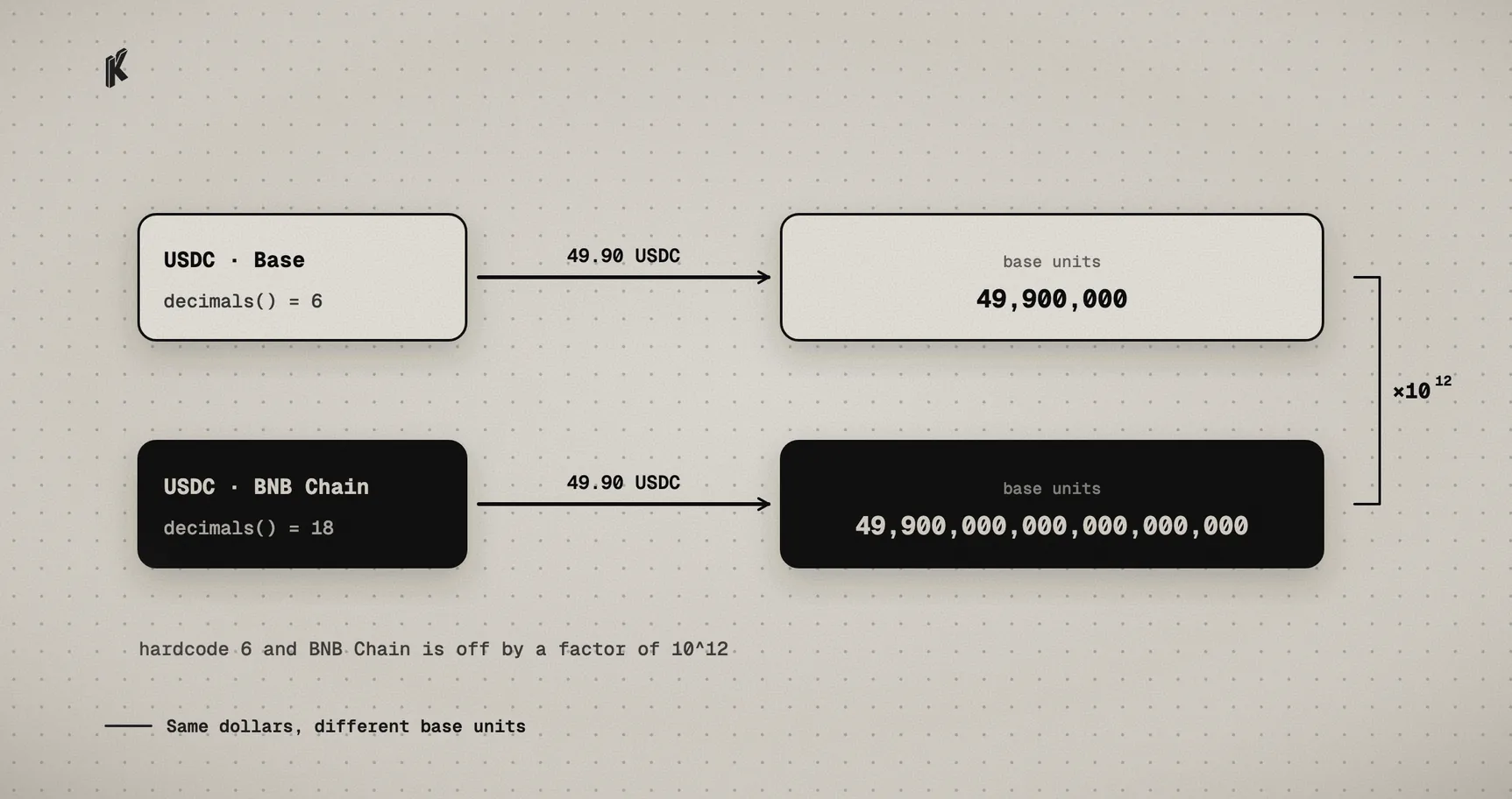
USDC and USDT use 6 decimals on every network Klap supports except BNB Chain, where both use 18. That's the whole exception, and it's enough to break a payment flow that works on seven networks and then sends or reads an amount a trillion times too large or too small on the eighth.
This post covers why, what the bug looks like in code, and the one habit that prevents it: read decimals for the token and network in front of you, and never assume it.
Base units
A token contract doesn't store 49.90. It stores an integer, and decimals says where the decimal point goes. With 6 decimals, one USDC is 1_000_000 base units, so 49.90 USDC is 49_900_000. With 18 decimals, one token is 1_000_000_000_000_000_000, so 49.90 is 49_900_000_000_000_000_000.
The amounts your customers see never show this. Wallets and explorers divide by the right power of ten before they print anything, and so does the stablecoin payment checker. The integers only show up when you build a transfer, parse a log or compare a raw value, and that's where a wrong assumption turns into a wrong amount.
Decimals by network
This is what the registry we use for our own tools holds for the mainnets we support:
| Network | USDC | USDT |
|---|---|---|
| Ethereum | 6 | 6 |
| Base | 6 | 6 |
| Optimism | 6 | 6 |
| Arbitrum | 6 | 6 |
| Polygon | 6 | 6 |
| Avalanche | 6 | 6 |
| BNB Chain | 18 | 18 |
| Arc | 6 | not listed |
Arc has no USDT entry in that registry. On Arc, USDC is the network's native gas token, exposed through an ERC-20 interface, and that interface reports 6 decimals, the same as USDC on Base. Accepting USDC on Arc covers how that works.
Testnet USDC on Base Sepolia, OP Sepolia and Ethereum Sepolia also uses 6.
The addresses behind each row, and the other details that differ per network, are on the free USDC and USDT contract addresses page. It lists each contract with its decimals and checks them against the chain in your browser.
Why BNB Chain is different
The BNB Chain versions of both tokens were deployed with 18 decimals, while the tokens on every other network in the table use 6. There's nothing to configure and nothing a payment provider can change about it. It's a property of the contract.
That also means a token's symbol tells you nothing about its decimals. Two contracts both called USDC can disagree, and a look-alike token can use any value it likes. The address on that specific network is what identifies a token, and decimals comes from the same place.
The bug
Here is code that's correct on seven networks:
import { parseUnits } from 'viem'const value = parseUnits('49.90', 6)
On Base that's 49_900_000n, which is 49.90 USDC. Run the same line for BNB Chain and the contract reads 49_900_000 as 0.0000000000499 of a token. The payment goes out as dust, or it fails a minimum check, and nothing in the code looks wrong.
The reverse is just as bad. Format a BNB Chain balance with 6 decimals and 49_900_000_000_000_000_000 becomes 49,900,000,000,000 tokens. A 10 USDT payment turns into either a dust amount or a huge one, depending on which direction the mistake runs. The factor is always the same: 10^18 divided by 10^6, or a trillion.
The mistake survives any test that runs on a network with 6 decimals, which is every other network in the table, so the first time the code meets 18 may be in production.
Read decimals from the contract
The fix is to ask the token once per network and keep the answer next to the address:
import { createPublicClient, http, parseAbi, parseUnits } from 'viem'import { bsc } from 'viem/chains'const client = createPublicClient({ chain: bsc, transport: http() })const erc20 = parseAbi(['function decimals() view returns (uint8)'])const decimals = await client.readContract({address: '0x55d398326f99059fF775485246999027B3197955',abi: erc20,functionName: 'decimals',})const value = parseUnits('49.90', decimals)
Take the address from a source you trust, such as the contract addresses page, and not from a token's name. decimals() answers for whatever contract sits at the address you give it, so a look-alike at the wrong address will answer happily with a plausible number.
If you hold a registry of addresses in your own code, store decimals in the same record as the address, so the two can't drift apart. A lookup keyed by network and token that returns both is harder to misuse than a constant of 6 that's imported in twelve places.
Amounts from Klap
If you create charges and read them back through Klap, you work in decimal amounts like 49.90 and never touch base units. Klap handles the conversion, and USDC vs USDT for merchants covers the other differences between the two tokens and the networks.
The rule only applies when you touch raw values yourself: building a transfer, decoding a Transfer log, comparing a balance read from a node, or reconciling against a block explorer. On those paths, resolve the address and the decimals together every time. Six decimals is true of most networks, and it was never a property of USDC itself.
For a quick sanity check, paste a transaction hash into the stablecoin payment checker. It shows the amount it read for each official transfer, so you can compare it with what your own code computed. A mismatch of twelve zeros is a decimals bug.