2026-12-10
How to Spot a Fake USDC Token
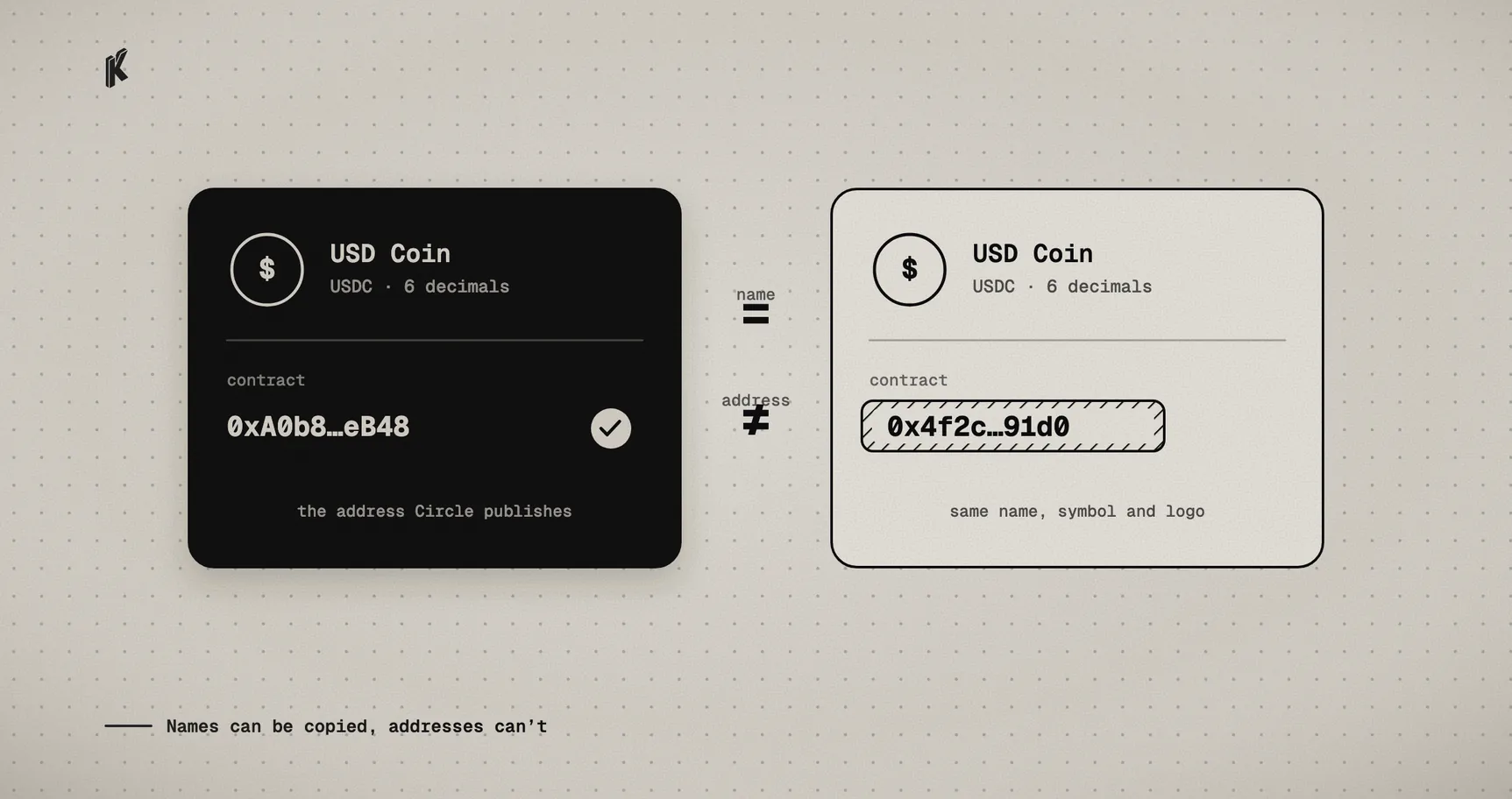
Deploying a token takes a few minutes and a few cents of gas. Nothing in that process checks the name. You can call your token "USD Coin", give it the symbol USDC, set it to 6 decimals, upload Circle's logo, and the chain will accept all of it. The result is a contract that looks like USDC in a wallet and isn't.
So the question "is this USDC?" has a precise answer, and it isn't about what the token calls itself.
What can be copied and what can't
Everything a token reports about itself is just a value its author chose. The name is a string. The symbol is a string. The decimals are a number. A wallet or an explorer reads those and shows them, and some add a logo from a list that a contract can try to get into.
What the author can't copy is the contract address. On a given network, each contract lives at exactly one address, and the real USDC on that network is at one specific address that Circle publishes. A fake can match the symbol, the name and the decimals and still sit at a different address, because the address is where it was deployed.
That makes the address the identity. Anything else is a description.
It's also per network. The same company issues USDC on several chains, but each deployment has its own address, so an address that is right on Ethereum is wrong on Base. Our list of official USDC and USDT contract addresses has one per network: Ethereum, Base, Optimism, Arbitrum, Polygon, Avalanche, BNB Chain and Arc. For example, USDC on Ethereum is 0xA0b86991c6218b36c1d19D4a2e9Eb0cE3606eB48 and on Base it's 0x833589fCD6eDb6E08f4c7C32D4f71b54bdA02913.
How to check one
Start from the transaction or the token you're looking at and find its contract address. In a wallet that's usually in the token's details. On an explorer, the transfer line links to the token, and the token page shows the contract address at the top.
Then compare it with a source you trust, and not with a search result or a message someone sent you. Circle publishes its contract addresses for each chain, and Tether does the same for USDT. Our contract list is a convenience copy. It also asks each contract for its symbol() and decimals() from your browser and tells you whether they match, but a match only shows the contract answers like the real token, and a fake can answer the same way. It doesn't replace comparing against the issuer's own documentation.
Compare the whole address, not the first and last few characters. Wallets and explorers shorten addresses with an ellipsis, and a look-alike can be generated to agree on the characters that are left visible.
If you're reading a transaction by hand, how to look up a USDC or USDT transaction by hash covers where the token contract shows up in the receipt.
The usual tricks
Fake tokens that arrive on their own. A token contract can emit a Transfer event for any address, whether or not the owner asked. So a token with the name USDC can appear in your wallet without you doing anything. Its balance can look large. It is a number inside a contract nobody trusts, and the fact that it shows up proves nothing. Treat anything you didn't choose as untrusted, and don't try to swap or send it.
Look-alike addresses. Someone sends a tiny transfer from an address that starts and ends like one you use often, hoping you copy it from your history next time. The defense is the same as above: take the recipient from a source you controlled, and don't copy it from a transaction list.
A real symbol on the wrong network. A genuine contract on one chain isn't the token on another. A payer who picks the wrong network, or a script that mixes up addresses between networks, ends up with a transfer that doesn't count where you expected it.
Bridged versions. On some networks there are tokens like USDC.e, which are bridged versions with their own contract addresses. They aren't the native token, and the contract list notes that Klap doesn't accept them.
Why a merchant verifies by address
If you take stablecoin payments, a fake token is more than a nuisance. A system that checks that a transfer has the symbol USDC and the right amount can be paid in a token that is worth nothing.
So the check has to be on the contract address. Klap works that way. Charge payments are verified against the configured contract for each token and network, never by reading symbol(), and a charge accepts only the (token, network) pairs we have an address for.
The symbol is also unreliable the other direction. On Arbitrum, the real USDT contract reports its name and symbol as USD₮0, which comes from Tether's cross-chain standard, and it was migrated that way in place in January 2025. A check on symbol() === 'USDT' would reject the real token there. Matching by address handles both cases without special rules.
Two more details from our network notes, so you aren't surprised by what "official" means in each case. On BNB Chain, the contracts behind USDC and USDT are Binance-Peg tokens and not Circle or Tether deployments, and both use 18 decimals instead of 6. On Arc, USDC is the chain's native gas asset, reachable at a fixed system address with an ERC-20 interface that reports 6 decimals.
Decimals are another reason to read the value from the contract's configuration. Hard-coding 6 for every network turns a payment on BNB Chain into the wrong amount.
What to do with a token you don't recognize
If a token shows up in your wallet and you didn't ask for it, leave it alone. Don't approve it, don't connect your wallet to a site it links to, and don't treat its balance as real.
If you're a merchant and a customer says they paid, find the transaction hash and check the token contract in the receipt, not the name on the explorer page. The free stablecoin payment checker does that comparison across every supported network, and it counts transfers from other contracts instead of listing them as USDC. To tie a payment to an order, use the signed webhook for the charge, as described in how to verify crypto payments.
If you're deciding which of the two stablecoins to accept in the first place, USDC vs USDT for merchants compares them.